56 countries, millions of products. But what does that actually tell a lender?
Inventory can stretch across countries, warehouses and millions of individual product records. In Asset-Based Lending, scale is interesting. Context is what makes the data useful.
If you visited our booth in Chicago, you may already know the answer to our Warehouse Challenge. Inventory warehouses in 56 countries are currently registered on the Finterface platform. As of 19 October 2026, the platform contained 14,963,369 individually registered products (SKUs). Those numbers make for a good quiz.
For a lender, however, the more interesting questions start immediately afterwards. Where is that inventory? What kind of warehouse is it in? What exactly is being stored there? How old is it? And how should all of that affect the borrowing base and the lender’s view of risk? That distinction matters because a count alone tells a lender very little.
A warehouse location is more than a pin on a map
Knowing the country in which inventory is held can be relevant to a financing decision. Inventory located in one jurisdiction may be eligible for financing, while inventory elsewhere may not be. The lender may have to consider whether its security interest can be exercised, whether particular inventory is acceptable under the credit agreement, or whether the risk characteristics of that location fit its lending policy.
That means “country” is not simply an address field. It can become one of the parameters used to determine whether inventory belongs in the borrowing base. And geography is only the starting point.
The warehouse itself matters too. Inventory held at a borrower-owned location is not necessarily the same proposition as stock kept with a third-party logistics provider. The relevant controls, access and outstanding obligations to the logistics provider can all become important to understanding the collateral.
A SKU count does not tell you what you are financing
The same principle applies to products. A portfolio containing millions of product records sounds substantial, but the number alone says remarkably little about collateral quality. A lender needs to understand the products behind it. Is the inventory raw material, work in progress or finished goods? Where is it stored? How old is it? How quickly does it move? Which eligibility rules apply?
The useful unit of information is not simply “one SKU”. It is closer to:
“This particular product, at this particular location, with these characteristics, at this point in time.”
That is a much richer basis for understanding collateral.
From a snapshot to a history
There is another dimension that is easy to miss: time. Knowing today’s inventory position is useful. Knowing how that position has evolved can tell a much richer story. When data is captured and retained structurally over time, lenders can look beyond a single reporting date. They can analyse movements, ageing and exceptions and identify changes that may deserve attention.
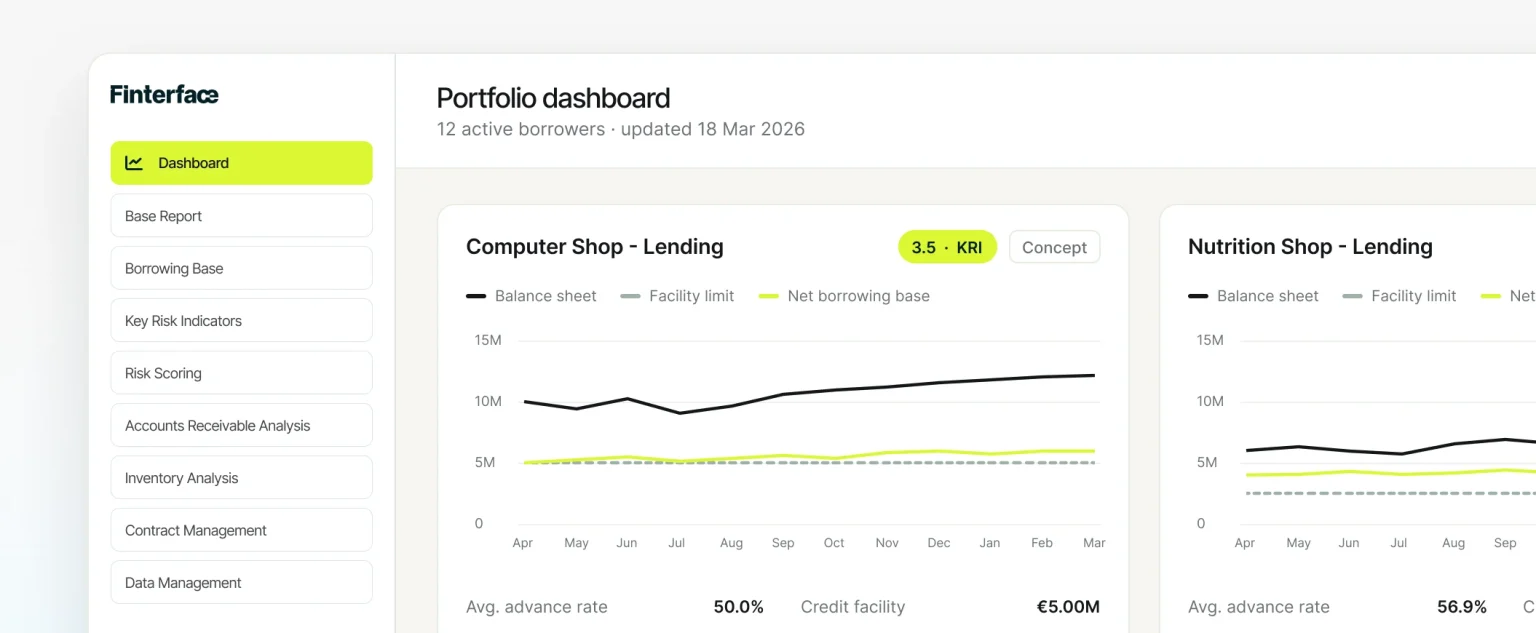
That is an important shift from traditional ABL monitoring based on periodic snapshots. Connecting borrower ERP, WMS and accounting data in a unified monitoring environment can support automated borrowing base calculations, continuous oversight and decision-making.
This is also where large volumes of structured data become genuinely interesting. The value is not in showing off the amount of data. Consistent historical data can help lenders examine risk evolution and identify patterns that warrant further investigation.
The interesting number is rarely just one number
So, back to our Chicago quiz. 56 countries. 14,963,369 individually registered products. They demonstrate scale, but scale is not really the point.
For an Asset-Based Lender, the value comes from connecting those data points: country, warehouse, product, ageing, revenue, eligibility, credit agreement and historical movements. Taken separately, they are facts. Taken together, they can help create a much clearer picture of the collateral supporting a facility.
That is the real challenge in modern Asset-Based Lending: not collecting ever more numbers, but turning granular operational data into information that can actually support lending decisions. And perhaps that is the more interesting answer to our quiz.
It is not simply about knowing where the inventory is. It is about understanding what is there.
Want to see what this looks like at portfolio and borrowing-base level?
See how Finterface turns borrower data into structured inventory monitoring, borrowing base calculations and risk insight.
Explore the Finterface platform →